
Solar energy in India has moved far past rooftop panels quietly powering a few lightbulbs. It’s now running farms, factories, kitchens, hospitals, and even entire villages that were once cut off from the power grid. From your morning shower to the vegetables in your local market, solar energy uses touch daily life in more places than most people realize. Here are 10 everyday ways solar energy is at work across the country.
TABLE OF CONTENT
- Powering Homes, Businesses & Remote Areas
- Heating Water the Solar Way
- Irrigating Farms With Solar Water Pumps
- Government Push Through PM-KUSUM Subsidies
- Lighting Up Streets and Public Spaces
- Cooking With Solar Ovens
- Driving Industrial Heat Processes
- Cutting Peak-Hour Costs for Factories
- Preserving Crops With Solar Cold Storage
- Powering Communities and India’s Largest Solar Parks
- Conclusion
- Frequently Asked Question (FAQs)
1. Powering Homes, Businesses & Remote Areas
Solar electricity isn’t limited to residential rooftops anymore. It now runs commercial buildings, housing societies, hospitals, schools, and industries, and even reaches remote rural areas with no grid access at all. A standard 1 kW system in India generates around 1,400–1,450 units of electricity annually, making it a genuinely practical power source for daily use.
2. Heating Water the Solar Way
One of the most common solar energy uses in Indian households is water heating. Active systems use pumps and controls, while passive systems work through natural convection with no moving parts at all. Both types are widely installed in homes and commercial spaces to cut down on geyser-related electricity bills.
3. Irrigating Farms With Solar Water Pumps
Solar water pumps convert sunlight into the power needed to draw groundwater or surface water for irrigation. Unlike diesel pumps, they run fuel-free and need far less upkeep over time. This makes them a practical fit for off-grid farmland where diesel and grid electricity are unreliable or expensive.
4. Government Push Through PM-KUSUM Subsidies
The PM-KUSUM scheme has made solar irrigation financially accessible for a large number of Indian farmers, offering subsidies ranging from 60% to 90% depending on the state. It supports farmers through small solar power plants, standalone pumps, and the solarization of existing grid-connected pumps. This scheme is a big reason solar has become one of the most common uses of energy in Indian farming today.
5. Lighting Up Streets and Public Spaces
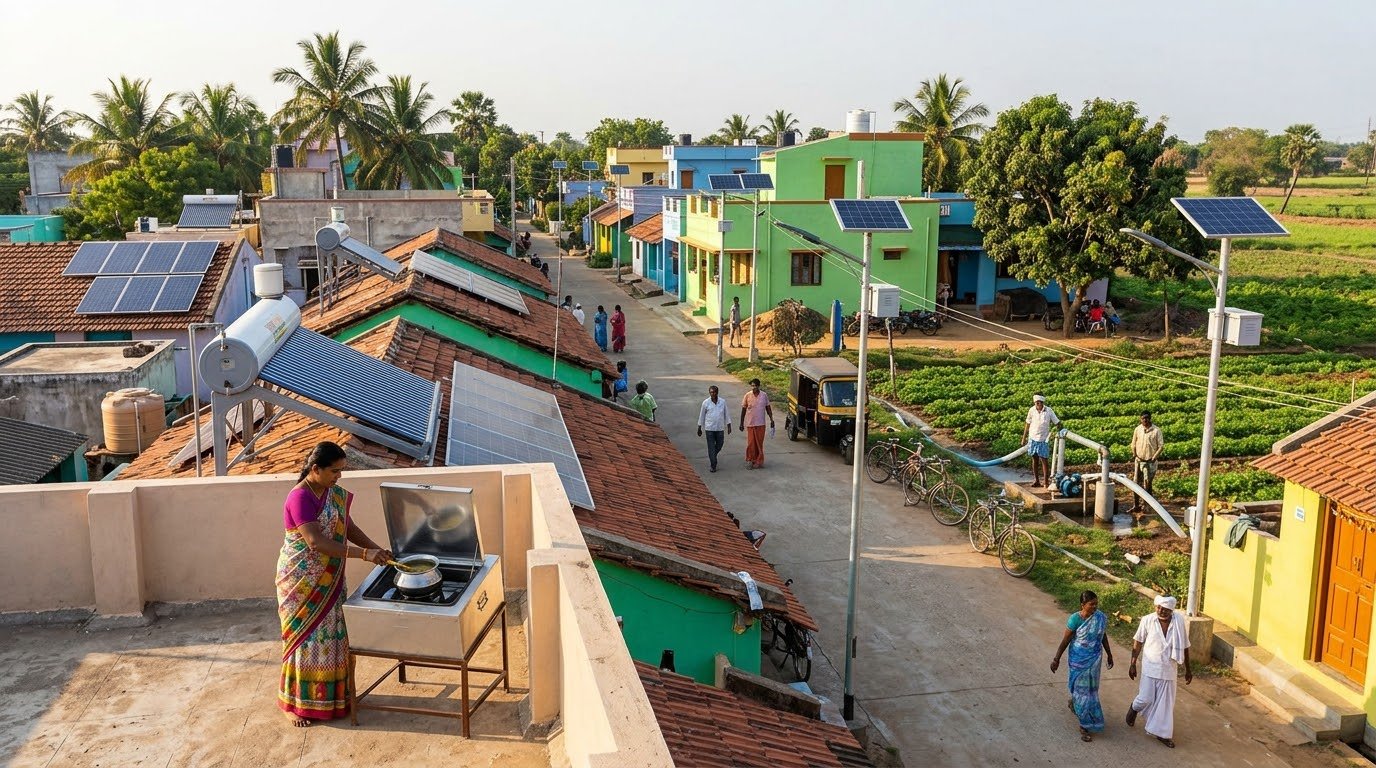
Municipalities across India increasingly rely on solar street lighting as a cost-effective alternative to grid power. It’s particularly useful in areas where laying new electrical infrastructure would be expensive or impractical. This keeps roads and public areas lit without adding pressure to civic electricity budgets.
6. Cooking With Solar Ovens
Solar cookers are a simple, often overlooked example of solar energy uses in daily life. They reduce a household’s dependence on LPG cylinders and electricity for everyday cooking. This use case is especially valuable in rural households where fuel access can be inconsistent.
7. Driving Industrial Heat Processes
Industries are tapping solar thermal energy for high-heat processes that go beyond simply generating electricity. In Gujarat, for instance, textile units use solar thermal systems to produce steam at 300°C for dyeing and drying fabric. This has meaningfully cut down heating costs in industrial production.
8. Cutting Peak-Hour Costs for Factories
Manufacturing units, including auto plants, use solar power to cover a large share of their afternoon electricity load. This helps them dodge the steep demand-based surcharges utilities charge during peak hours. For industries, this makes solar as much a cost-control strategy as a power source.
9. Preserving Crops With Solar Cold Storage
Solar-powered cold storage is increasingly used to keep perishable produce fresh closer to the farm. This directly reduces spoilage across the agricultural supply chain, a persistent challenge in India’s food economy. It’s a growing, practical example of solar energy used to solve a real farm-level problem.
10. Powering Communities and India's Largest Solar Parks
Solar energy also scales well beyond individual rooftops. Housing societies are increasingly buying into shared solar farms to lower group electricity costs, while massive projects like Rajasthan’s Bhadla Solar Park power over a million homes on their own. Together, these examples show how the same technology works at both a neighborhood and a national scale.
Conclusion
From heating water to running entire textile plants, solar energy uses in India stretch across homes, farms, factories, and city streets. What started as a way to cut electricity bills has grown into infrastructure that entire communities and industries now depend on. If you’re considering how solar could fit into your own home or business, it’s worth exploring which of these applications makes the most sense for you. Get in touch to find the right solar solution for your needs.