
Switching to solar sounds like a great idea until the big question hits you: will it actually save money in the long run? That’s where solar panel ROI comes in. It tells you exactly how much value you’re getting back from your investment, and how soon you’ll start seeing real savings on your electricity bills.
This guide breaks down solar panel ROI in the simplest way possible, with real numbers, easy formulas, and practical tips, so you can make a confident decision before you install.
TABLE OF CONTENT
- Why Understanding Solar Panel ROI Matters
- What Is the Solar Panel Payback Period?
- How to Calculate Solar Panel Payback Period
- How to Calculate Solar Panel ROI
- Real-Life Example of Solar Panel ROI Calculation
- Common Mistakes That Lower Solar Panel ROI
- Tips to Maximize Your Solar Panel ROI
- Conclusion
- Frequently Asked Questions
Why Understanding Solar Panel ROI Matters
Before spending money on any big investment, you’d want to know when you’ll get your money back, right? Solar panels are no different. Knowing your solar panel ROI helps you:
- Compare solar against your current electricity costs
- Decide which system size fits your budget
- Understand how subsidies and incentives affect your final savings
- Set realistic expectations instead of relying on sales pitches
Without this calculation, you’re basically guessing. With it, you’re making an informed financial decision.
What Is the Solar Panel Payback Period?
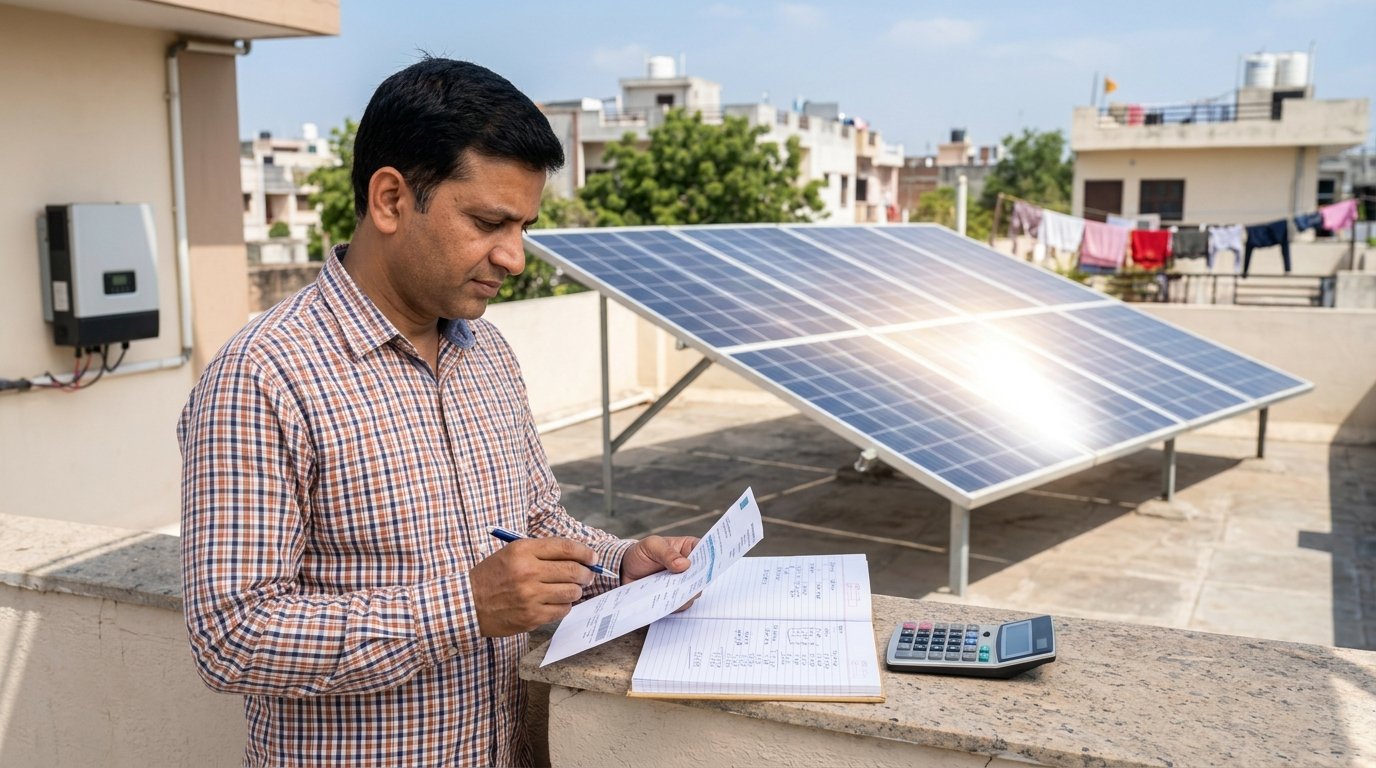
The payback period is the time it takes for your solar system to “pay for itself” through the money you save on electricity bills. Once you cross that point, every unit of solar power you generate is essentially free money in your pocket.
This number directly feeds into your solar panel ROI, since a shorter payback period usually means a stronger return over the system’s lifetime (which is typically 25+ years).
How to Calculate Solar Panel Payback Period
Calculating this doesn’t require a finance degree. Just three simple step
Step 1: Calculate Total Installation Cost
Add up everything: panels, inverter, batteries (if any), wiring, labour, and any additional equipment. This is your total upfront investment.
Step 2: Calculate Annual Savings
Look at your average electricity bill before solar, then estimate how much of that you’ll offset with solar power. Don’t forget to factor in any solar subsidy or state incentive, since that reduces your effective installation cost and boosts your solar panel ROI.
Step 3: Divide Cost by Annual Savings
Payback Period = Total Installation Cost ÷ Annual Savings
For example, if your system costs ₹1,50,000 and saves you ₹25,000 a year, your payback period is 6 years. After that, you’re generating pure savings for the next 19+ years of the panel’s life.
How to Calculate Solar Panel ROI
Once you know your payback period, calculating solar panel ROI is straightforward.
Simple ROI Formula
ROI (%) = (Total Savings Over System Lifetime − Total Installation Cost) ÷ Total Installation Cost × 100
This gives you a percentage that shows how much you gain relative to what you spent, over the entire life of the system, not just the payback year.
Factors That Improve Your Solar Panel ROI
Government Subsidies
Subsidy schemes reduce your initial installation cost significantly, which shortens the payback period and increases your overall solar panel ROI. Always check current subsidy eligibility before finalizing your system size.
Net Metering
Net metering lets you send excess solar power back to the grid in exchange for credits. This means even the energy you don’t use directly still contributes to your savings, improving your solar investment return.
Panel Efficiency and Maintenance
Higher efficiency panels generate more power per square foot, and regular maintenance keeps that efficiency from dropping over time. Dust, shading, and poor upkeep are silent killers of solar panel ROI.
Real-Life Example of Solar Panel ROI Calculation
Let’s say a household installs a 3kW rooftop system:
- Installation cost (after subsidy): ₹1,80,000
- Annual electricity bill savings: ₹30,000
- Payback period: 6 years
- System lifespan: 25 years
- Total savings over 25 years: ₹7,50,000
ROI = (7,50,000 − 1,80,000) ÷ 1,80,000 × 100 = 316%
That’s a solid solar panel ROI for a one-time investment that keeps paying off for decades.
Common Mistakes That Lower Solar Panel ROI
- Undersizing or oversizing the system without checking actual power consumption
- Skipping regular cleaning and maintenance, which reduces output over time
- Ignoring net metering policies in your area
- Not comparing multiple quotes before installation, leading to overpaying
- Forgetting inverter replacement costs, which usually come up once during the system’s lifetime
Avoiding these mistakes keeps your payback period short and your returns strong.
Tips to Maximize Your Solar Panel ROI
- Choose the right system size based on your actual electricity consumption, not guesswork.
- Apply for all available subsidies and incentives before installation.
- Opt for good quality panels and inverters, even if slightly pricier upfront.
- Schedule periodic maintenance to avoid efficiency drops.
- Monitor your energy generation and consumption using an app or meter to catch issues early.
Conclusion
Calculating your solar panel ROI doesn’t have to be complicated. With a simple formula, a bit of data about your electricity usage, and awareness of subsidies and maintenance costs, you can clearly see how solar pays off over time. The numbers speak for themselves, solar isn’t just an eco-friendly choice, it’s a smart long-term investment.
If you’re ready to explore the right system size and get an accurate cost estimate for your home or business, exploring professional solar panel installation services can help you get started with a setup that fits your budget and energy needs.