
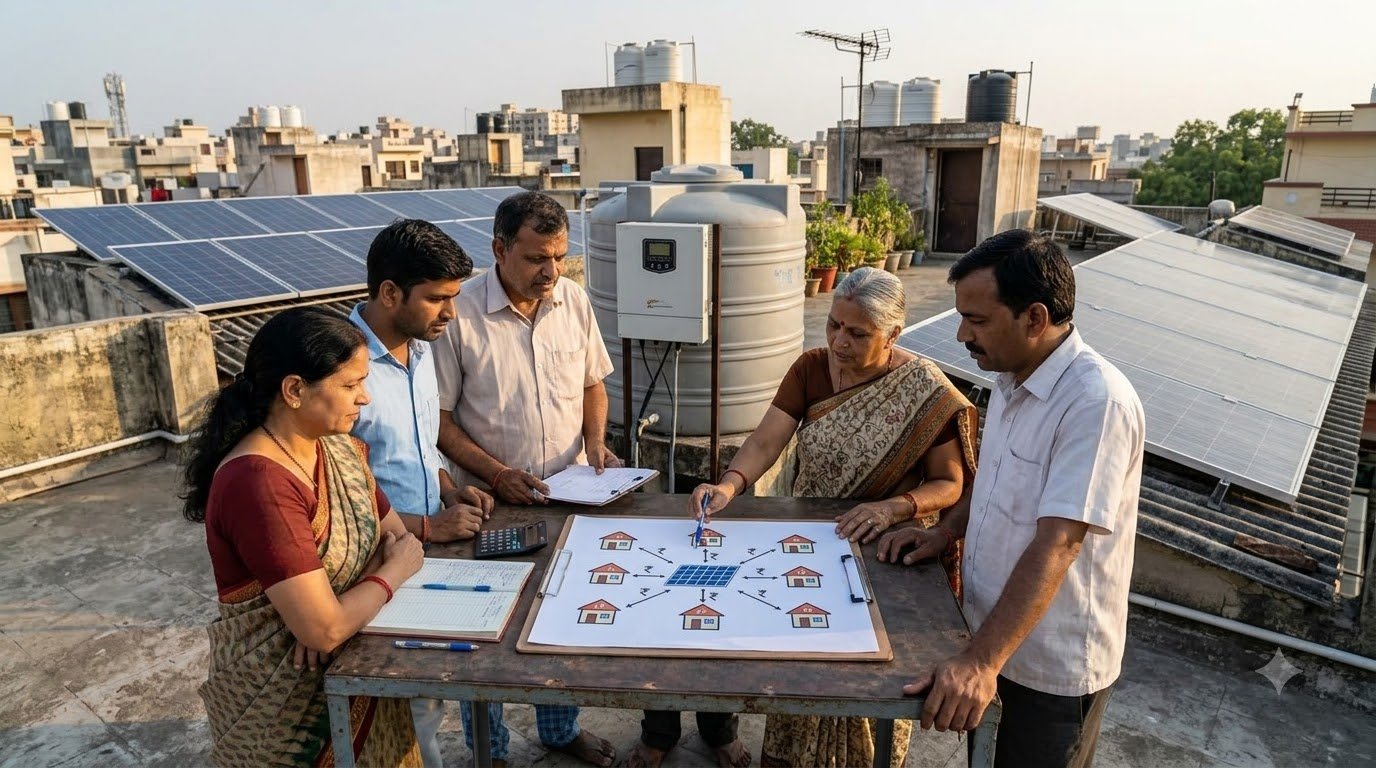
Going solar doesn’t have to be a single-household decision anymore. For apartment residents, solar panels for apartments work best as a shared investment — one system, split costs, and savings that reach every flat in the building. Here’s how solar for housing societies actually make this work, from approvals to splitting the bill fairly among neighbours.
TABLE OF CONTENT
What Solar for Apartments Actually Looks Like
In most cases, solar panels for apartments aren’t installed flat by flat — they’re set up as one shared system on the terrace, powering common-area loads like lifts, water pumps, corridor lighting, and clubhouse equipment. Since every resident uses these common areas daily, the electricity savings benefit the whole society, not just one household. This shared-system approach is by far the most practical and widely adopted model across Indian cities.
Getting Society Approval First
Since the terrace is common property, no individual resident can install solar there without the society’s formal consent. Most RWAs require a general body resolution, typically needing 75% member approval or whatever threshold their bylaws specify. This approval step is usually what determines how quickly a society’s solar project actually moves forward, so getting buy-in early matters more than the technical planning itself.
The Subsidy Structure for Societies
Societies have access to a subsidy path built specifically for shared installations — ₹18,000 per kW for common-area solar under PM Surya Ghar, up to a set capacity limit. Some states go further; Delhi, for example, offers additional per-unit incentives specifically for RWAs going solar. This makes solar panels for apartments financially different, and often more attractive, than typical individual homeowner subsidies.
How the Savings Reach Residents
Because the shared system mainly offsets the society’s common electricity bill, the most direct benefit for residents is a drop in monthly maintenance charges. Group Net Metering lets surplus power be credited across multiple meters owned by the same society entity. Virtual Net Metering goes a step further, allowing one shared plant to distribute generation credits across individual flat meters in a pre-agreed ratio — a model that’s gaining traction in cities like Delhi.
Splitting the Cost Fairly Among Neighbours
There’s no universal formula here — most societies split the cost proportionally by flat size, ownership share, or simply divide it equally, based on what the committee decides. Beyond just splitting costs, two broader ownership models exist too: a CAPEX model where the society invests directly and owns the plant outright, or a third-party PPA model where an external company owns and runs the system while the society just pays for the power it uses. Each has different upfront costs and long-term trade-offs worth discussing at a general body meeting before committing.
Is Your Society's Rooftop Solar-Ready?
Not every rooftop is automatically ready for a shared system — shading, structural load capacity, and how much unshaded space is available all affect what’s realistically possible. Most professional installers offer a preliminary rooftop audit before drawing up a formal proposal, which is worth doing early in the conversation. All installations also need to comply with CEA regulations, BIS norms, and local DISCOM interconnection requirements, so working with an experienced installer matters more here than in a typical single-home setup.
Conclusion
Solar panels for apartments turn what feels like a big, complicated decision into a shared one — split costs, shared savings, and a lower maintenance bill for everyone in the building. From getting society approval to figuring out a fair cost-split model, most of the process comes down to good planning and the right installation partner. If your housing society is exploring solar for common areas, reach out for a rooftop assessment and a proposal tailored to your society’s needs.