
Every business owner has felt that sinking feeling when the lights go out mid-workday. A power cut lasting just 10 minutes can wipe out unsaved work, freeze critical operations, and leave customers frustrated. Now imagine this happening regularly. That’s the reality for thousands of businesses across India, and the solution isn’t just a generator anymore. A UPS system paired with solar backup is fast becoming the smart, cost-effective choice for businesses that can’t afford downtime.
TABLE OF CONTENT
- Power Cuts Are Costing Your Business More Than You Think
- What Is a UPS System and Why Does Your Business Need One?
- Solar Backup — The Smarter Layer of Protection
- 5 Real Reasons Businesses Are Switching to Solar UPS
- Who Needs a Solar UPS System?
- Choosing the Right UPS Battery for Your Setup
- On-Grid vs Off-Grid Solar Backup — Which Is Right for Your Business?
- Conclusion
- Frequently Asked Questions
Power Cuts Are Costing Your Business More Than You Think
Most business owners only count the obvious losses of a few hours of unproductive time, maybe a damaged device. But the real cost of an unreliable power supply runs deeper:
- Data loss from abrupt shutdowns
- Equipment damage caused by voltage spikes and sudden power surges
- Lost revenue when operations pause unexpectedly
- Customer trust that quietly erodes with every delay
A dedicated business UPS addresses all of these at once. It keeps your systems running the moment grid power fails no interruption, no delay, no restart needed.
What Is a UPS System and Why Does Your Business Need One?
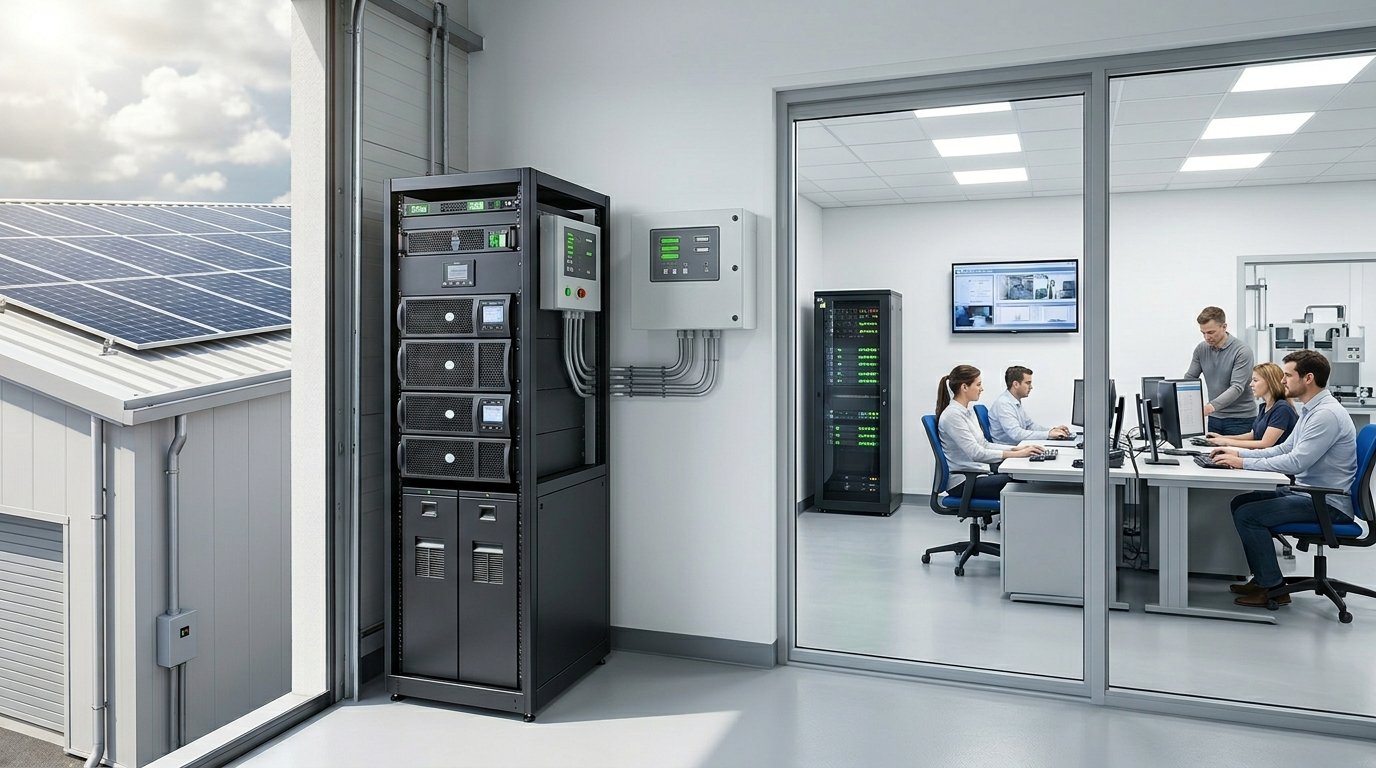
A UPS (Uninterruptible Power Supply) is a device that provides instant battery backup when the main power supply cuts out. Unlike a generator that takes time to kick in, a UPS switches over in milliseconds so your computers, servers, billing systems, and other critical devices never even notice the outage.
Types of UPS Systems Suitable for Businesses
Not all UPS units are the same. Here’s a quick breakdown:
- Offline/Standby UPS — Basic protection, ideal for small setups
- Line-Interactive UPS — Handles voltage fluctuations; suitable for most offices
- Online/Double-Conversion UPS — Continuous clean power; best for servers, data centers, and high-end equipment
Choosing the right type depends on your load requirements and how sensitive your equipment is.
Solar Backup — The Smarter Layer of Protection
A UPS alone gives you backup for minutes to a few hours. But pair it with a solar backup system and you’re looking at a setup that can power your business through extended outages and slash your electricity bill at the same time.
A solar inverter converts energy from solar panels into usable electricity. When connected to a UPS battery and a solar array, it creates a self-sustaining power loop: the solar panels charge the batteries during the day, and the batteries power your business when the grid fails day or night.
How a Solar UPS System Works
- Solar panels generate DC electricity from sunlight
- The solar inverter converts DC to AC for your devices
- Excess energy charges the UPS battery bank
- When grid power drops, the battery bank takes over instantly
- The system recharges itself the next day without a single electricity unit billed
This is what’s called a hybrid solar UPS setup and it’s the most efficient power backup solution available for commercial use today.
5 Real Reasons Businesses Are Switching to Solar UPS
1. No More Dependency on the Grid
Businesses in areas with frequent load shedding know the frustration of planning around power schedules. A solar UPS system reduces your dependence on the grid significantly, you generate and store your own power.
2. Significant Drop in Electricity Bills
An inverter UPS running on solar energy means a large chunk of your monthly electricity consumption is covered by free sunlight. For businesses running heavy equipment, computers, or refrigeration, the savings show up fast.
3. Protection for Sensitive Equipment
Voltage fluctuations are just as damaging as full outages. A quality UPS system continuously conditions the power supply to your devices filtering out surges, sags, and spikes before they cause harm.
4. Low Maintenance, Long Life
Modern UPS batteries and solar inverters are built to last. With minimal moving parts and smart monitoring features, the system essentially looks after itself with just periodic checks needed.
5. Better for the Environment
More customers and partners today factor in sustainability when choosing who to work with. Running your business on clean solar energy is a visible commitment to responsible operations and that matters.
Who Needs a Solar UPS System?
Any business where downtime is not an option. That includes offices, retail stores, clinics, manufacturing units, and hotels. Many leading Indian institutions have already shown how solar-powered systems deliver reliable performance at scale. That includes:
- Offices and co-working spaces — Protect computers, servers, and networking gear
- Retail stores — Keep billing systems and refrigeration running
- Clinics and diagnostic centres — Medical equipment cannot afford sudden power loss
- Manufacturing units — Prevent mid-process failures and equipment damage
- Educational institutions — Keep labs, projectors, and administration systems running
- Hotels and hospitality — Uninterrupted power is part of the guest experience
If your business relies on electricity to operate, which is all of them, a reliable power backup system is not optional. It’s infrastructure.
Choosing the Right UPS Battery for Your Setup
The battery is the heart of any backup power system. A poor-quality battery means shorter backup time, faster degradation, and frequent replacements that add up.
Choosing the Right UPS Battery for Your Setup
- Capacity (Ah rating) — Higher Ah means longer backup time
- Battery type — Tubular, VRLA (sealed), or Lithium-Ion, each with different trade-offs
- Cycle life — How many charge-discharge cycles it can handle
- Compatibility — Must match your UPS and solar inverter specifications
- Warranty — A strong warranty signals manufacturer confidence in the product
Getting the sizing right is crucial. Under-sized batteries leave you short during long outages; over-sized ones waste money upfront.
On-Grid vs Off-Grid Solar Backup — Which Is Right for Your Business?
Feature | On-Grid Solar | Off-Grid Solar |
Requires grid connection | Yes | No |
Works during power cuts | No (without battery) | Yes |
Best for | Low-outage areas | Frequent outage areas |
Battery storage needed | Optional | Essential |
Cost | Lower upfront | Higher upfront |
For most Indian businesses dealing with regular outages, an off-grid or hybrid solar UPS setup offers the most practical protection. It keeps you running regardless of what the grid does.
Conclusion
Power reliability is no longer a luxury, it’s a business requirement. A well-sized UPS system with solar backup doesn’t just keep your lights on. It protects your data, your equipment, your revenue, and your reputation.
The combination of an inverter UPS, a quality UPS battery, and a solar inverter creates a setup that’s resilient, cost-efficient, and future-ready. Whether you run a small office, a clinic, or a mid-sized commercial facility the case for going solar is clear, and the technology to do it reliably is right here.
If you’re ready to stop reacting to power cuts and start running on your own terms, explore the range of solar and UPS solutions available to find the right fit for your business.