
Power cuts strike without warning. One minute your team is closing deals or processing orders; the next, screens go blank and productivity grinds to a halt. In today’s always-on world, UPS systems are no longer a luxury, they’re the silent heroes keeping your business alive during those unpredictable moments. But here’s the catch: not every UPS systems solution works the same way. Some are basic backups, while others deliver seamless, ultra-clean power like a high-end generator that never sleeps.
This guide cuts through the technical jargon to compare online UPS and offline UPS in real-world business terms. We’ll explore which one truly matches your needs, when a solar powered UPS system might be the smarter long-term play, and how commercial UPS backup can scale with your growth. By the end, you’ll know exactly what to choose without needing an engineering degree.
TABLE OF CONTENT
- How Offline UPS Keeps Things Simple
- The Always-On Protector, Inside Online UPS Technology
- Online UPS vs Offline UPS Comparison
- Why a Solar Powered UPS System Is Gaining Fans
- Commercial UPS Systems Backup
- Choosing the Right UPS Systems: 5 Questions Every Business Owner Must Ask
- Power Up Your Decision And Your Business
- Frequently Asked Questions About UPS Systems
How Offline UPS Keeps Things Simple
Think of an offline UPS systems as your trusty spare tire. It sits quietly in the corner, plugged into the mains, happily passing grid power straight to your devices. The moment electricity dips or fails, it switches to battery power in a few milliseconds (usually 2–10 ms).
Why businesses love it:
- Super affordable upfront
- High efficiency, almost no energy wasted while on mains power
- Compact and easy to install anywhere
- Perfect for non-critical loads like printers, POS systems, or small workstations
The trade-off? There’s a tiny switchover delay, and it doesn’t clean or regulate incoming power. If your grid voltage fluctuates wildly, your equipment still feels it. Great for small offices or shops with stable electricity, but not ideal for sensitive servers or medical gear.
The Always-On Protector, Inside Online UPS Technology
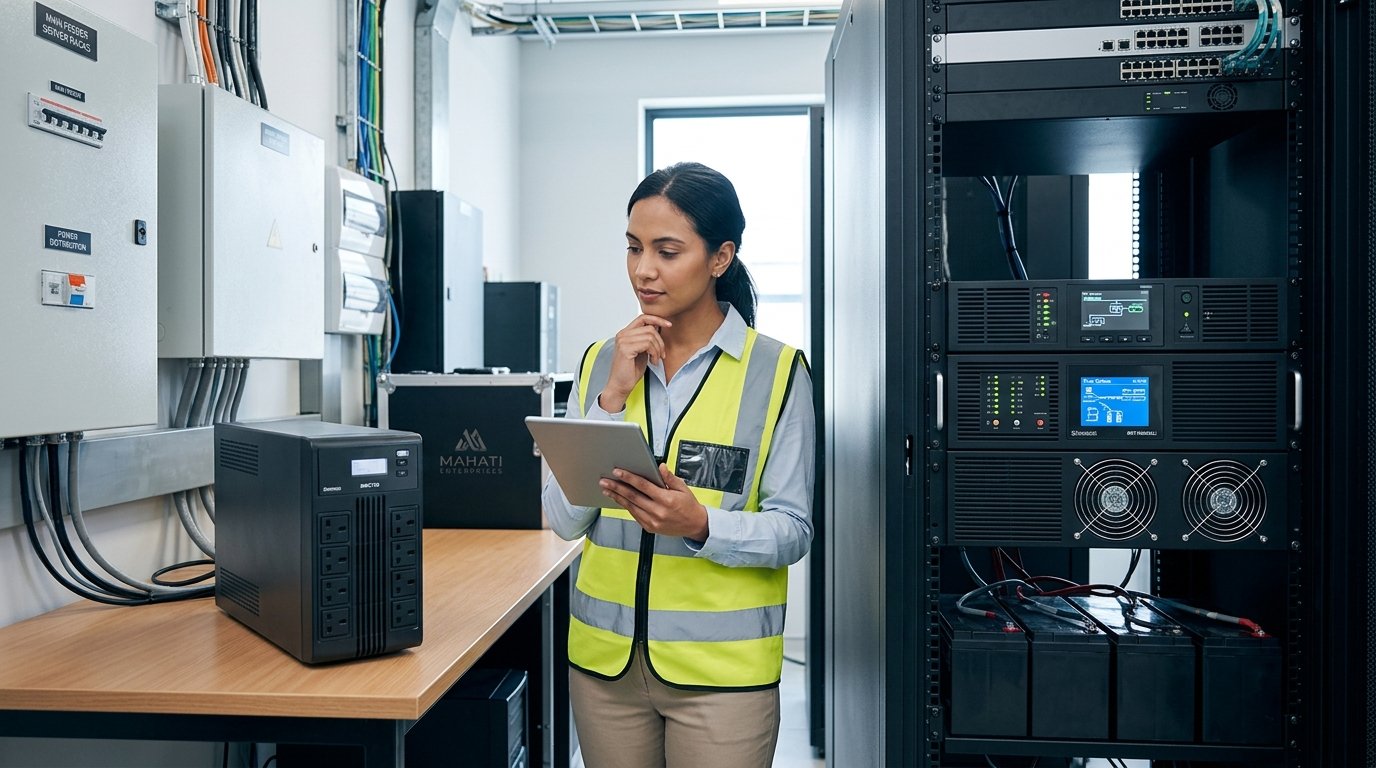
Now picture an online UPS systems as a full-time bodyguard. It never lets grid power touch your equipment directly. Instead, it constantly converts incoming AC to DC, then back to clean AC through its inverter. Your devices run off this perfectly regulated power 24/7 even when the mains are perfectly fine.
Standout benefits:
- Zero transfer time (your equipment never notices a power blip)
- Pure sine wave output that protects delicate electronics from surges, spikes, and noise
- Built-in voltage regulation and filtering
- Ideal for data centers, servers, telecom racks, or any mission-critical setup
The reality check: It costs more and uses slightly more energy because of the double-conversion process. But for businesses where even a split-second downtime equals lost revenue, the investment pays for itself fast.
Online UPS vs Offline UPS Comparison
Let’s make this Online vs Offline UPS Comparison crystal clear with a quick side-by-side look:
Feature | Offline UPS Systems | Online UPS Systems |
Switch Time | 2–10 milliseconds | Zero (seamless) |
Power Quality | Moderate (passes grid power) | Excellent (pure sine wave) |
Efficiency on Mains | Very high (~95–98%) | Lower (due to double conversion) |
Cost | Budget-friendly | Higher initial investment |
Best For | Basic office gear, POS, lighting | Servers, medical equipment, data centers |
Voltage Regulation | Limited | Full regulation and filtering |
Battery Usage | Only during outages | Constant (batteries stay charged) |
This online UPS vs offline UPS showdown shows one clear truth: choose based on how much your downtime actually costs. A small retail shop might save thousands with an offline UPS. A cloud-based service provider could lose lakhs in minutes without an online UPS.
Why a Solar Powered UPS Systems Is Gaining Fans
Power reliability doesn’t have to mean higher electricity bills. A solar powered UPS system blends renewable energy with backup smarts. Solar panels feed energy straight into the UPS batteries during the day, reducing grid dependence and slashing costs. When the sun sets or clouds roll in, the system seamlessly switches to stored solar power or grid backup. Businesses in areas with frequent outages are switching fast, often integrating these units with larger solar panel systems on-grid vs off-grid vs hybrid solar system configurations to maximize efficiency. It’s eco-friendly, qualifies for green incentives, and ensures your commercial setup runs on free sunlight while enjoying rock-solid protection.
Commercial UPS Systems Backup
Growing businesses need more than a desktop-sized box. Commercial UPS backup solutions deliver centralized, high-capacity power for entire floors, server rooms, or manufacturing lines. These robust UPS systems can support hundreds of kilowatts and integrate with building management systems for remote monitoring.
Look for features like parallel redundancy (multiple units working together) and hot-swappable batteries so you never shut down for maintenance. Whether you run a warehouse, hospital wing, or corporate office, the right commercial UPS backup ensures zero productivity loss during extended outages.
Choosing the Right UPS Systems: 5 Questions Every Business Owner Must Ask
- How sensitive is your equipment? (Servers hate even tiny glitches.)
- What’s your average outage duration and frequency?
- How much downtime can your budget actually afford?
- Do you want to cut long-term energy costs with solar integration?
- Will your power needs grow in the next 2–3 years?
Answer these honestly and the right UPS systems choice becomes obvious.
Power Up Your Decision And Your Business
Choosing between online UPS and offline UPS isn’t about picking the “best” technology—it’s about picking the smartest one for your reality. Whether you need simple, cost-effective backup or bulletproof, solar-integrated protection, the right system keep revenue flowing and stress levels low.
Ready to power your business without interruptions? Discover the perfect UPS systems and solar powered solutions tailored for you and take the first step toward truly reliable energy independence.