
Going solar is one of the smartest moves you can make for your electricity bills, your home, and the environment. But here’s the thing: a poorly planned solar power setup can cost you more than it saves. Many homeowners and businesses jump into solar energy without knowing the pitfalls, and they end up with systems that underperform, break down early, or never deliver the promised savings.
This guide walks you through the 5 most common solar power mistakes and more importantly, how to dodge every single one of them.
TABLE OF CONTENT
- Mistake 1: Skipping a Proper Site and Energy Assessment
- Mistake 2: Choosing the Wrong System Size
- Mistake 3: Ignoring Solar Panel Placement and Shading
- Mistake 4: Neglecting Solar Panel Maintenance
- Mistake 5: Picking the Wrong Inverter and Battery Setup
- Quick Summary: The 5 Solar Mistakes at a Glance
- Conclusion
- Frequently Asked Questions
Mistake 1: Skipping a Proper Site and Energy Assessment
Why This Happens
Most people get excited about solar and rush straight to buying panels. They skip the most important first step in understanding whether their site and energy needs actually justify the system they’re buying.
What Goes Wrong
Without a proper assessment, you risk installing a system that’s either too small (leaving you dependent on the grid) or too large (overspending on capacity you’ll never use). A home in a shaded area or with a north-facing roof in India will generate far less power than expected.
How to Avoid It
Before any solar panel installation, always get a viability study done. This involves analysing your rooftop’s solar potential, your monthly energy consumption, the best system size for your needs, and your expected return on investment. Think of it as a blueprint before you build. No blueprint, no guarantee.
Mistake 2: Choosing the Wrong System Size
Why This Happens
People often size their system based on their current electricity bill, not their actual energy usage patterns. Others copy what a neighbour installed without realising their needs are completely different.
What Goes Wrong
An undersized system won’t cover your power needs, meaning you’ll still pay heavy electricity bills. An oversized system wastes money upfront and may not even be eligible for full net metering benefits. Either way, you lose.
How to Avoid It
Calculate your average daily energy consumption in kilowatt-hours (kWh). Factors in future needs are: Are you planning to add an EV, an air conditioner, or expand your business? A correctly sized rooftop solar system should comfortably meet your day-to-day needs with a reasonable buffer. Consult a solar professional who does load calculations before recommending a system.
Mistake 3: Ignoring Solar Panel Placement and Shading
Why This Happens
People assume that if panels are on the roof, they’ll work fine. What they don’t account for is shading from nearby trees, water tanks, chimneys, or neighbouring buildings even partial shading has a massive impact.
What Goes Wrong
In a standard string inverter system, if even one panel is shaded, the entire string’s output drops. That’s not a 10% dip; it can mean a 50–80% reduction in output from that string. Poor tilt angle also reduces how much sunlight panels absorb throughout the day.
How to Avoid It
Panel placement and tilt optimization must be part of your solar panel installation plan from day one. In India, panels are ideally south-facing at a tilt angle roughly equal to your site’s latitude. If shading is unavoidable, micro-inverters or power optimisers can help each panel work independently. A detailed site-specific design will account for all of this before installation begins.
Mistake 4: Neglecting Solar Panel Maintenance
Why This Happens
Once the panels are up and the system is running, many people assume it’s set-and-forget. Solar panels are marketed as low-maintenance and they are but “low maintenance” doesn’t mean “zero maintenance.”
What Goes Wrong
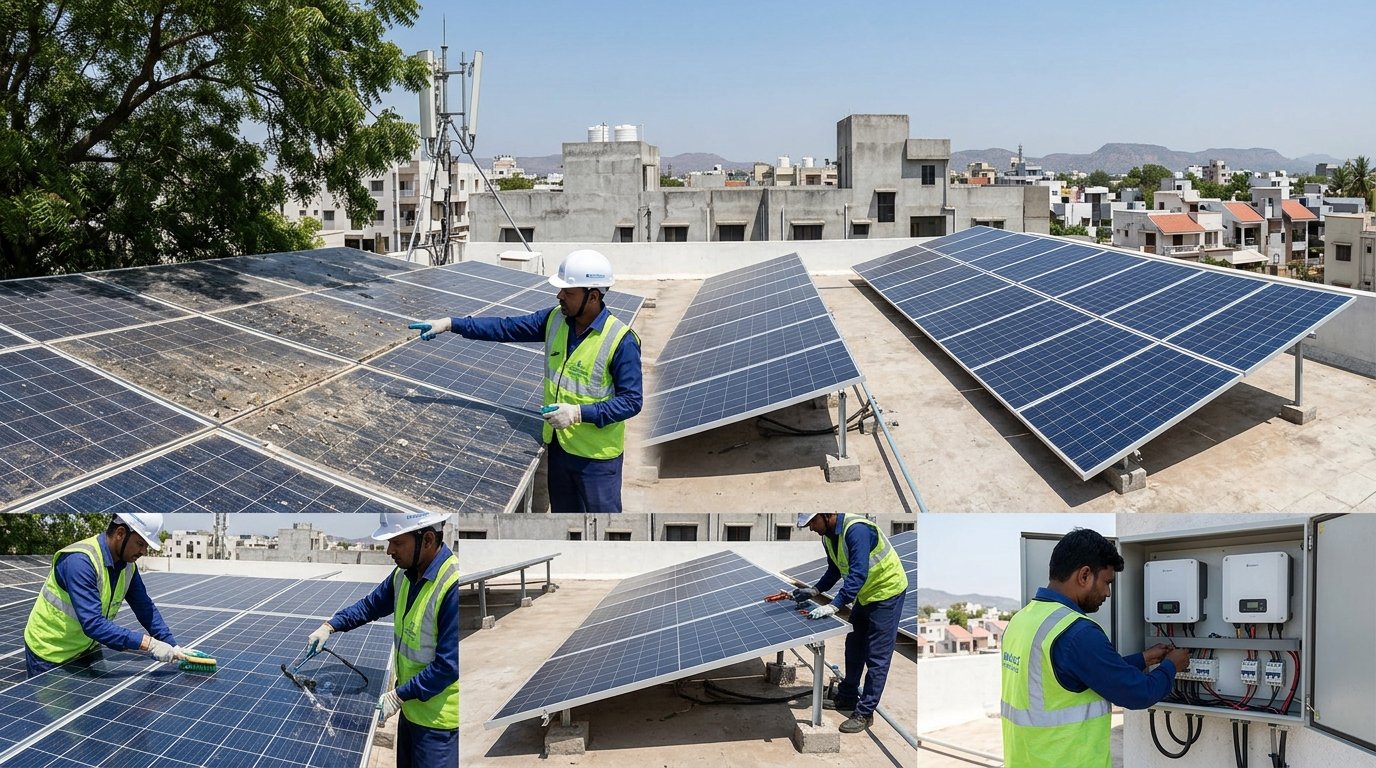
Dust, bird droppings, fallen leaves, and pollution build up on panel surfaces over time. This layer of grime blocks sunlight and reduces solar panel efficiency significantly. In dusty Indian cities, panels can lose up to 25–30% efficiency within weeks of not being cleaned. Add to this unchecked wiring, loose connections, or hotspot development and you’re looking at both performance loss and potential safety risks.
How to Avoid It
A basic solar panel maintenance routine goes a long way:
- Clean panels every 2 weeks if you’re in a dusty area; once a month in cleaner environments.
- Check for visible damage — cracks, discolouration, or hotspots on panel surfaces.
- Monitor your inverter output through its app or display. A sudden drop in daily generation is a red flag.
- Trim nearby trees and branches regularly so they don’t block sunlight or drop debris.
Schedule a professional check-up at least once a year to inspect wiring, connectors, and inverter health.
Mistake 5: Picking the Wrong Inverter and Battery Setup
Why This Happens
Inverters and batteries are often an afterthought. People focus on the panels which are the visible, exciting part and don’t pay enough attention to what converts and stores all that energy.
What Goes Wrong
A cheap inverter may not handle load spikes, may fail during power cuts, or may not be compatible with your panel configuration. Similarly, choosing the wrong battery chemistry, capacity, or brand can mean shorter backup time, faster degradation, and more replacements over time. In a country like India, where grid outages are still common in many areas, a poorly matched battery bank makes your solar power investment far less useful.
How to Avoid It
Match your inverter type to your actual use case:
- On-grid inverter — if you want to reduce bills and feed excess power back to the grid.
- Off-grid inverter — if you want full energy independence with battery backup.
- Hybrid inverter — if you want both grid connection and battery backup.
For batteries, prioritise capacity (measured in kWh), depth of discharge (DoD), cycle life, and warranty. Lithium-ion batteries cost more upfront but last significantly longer than lead-acid alternatives. Always buy from a reliable supplier with after-sales support, not just the cheapest listing online.
Quick Summary: The 5 Solar Mistakes at a Glance
Mistake | Fix | |
1 | Skipping site and energy assessment | Do a viability study first |
2 | Wrong system size | Calculate actual load + future needs |
3 | Poor panel placement or shading | Get a site-specific design done |
4 | No maintenance routine | Clean, monitor, and inspect regularly |
5 | Wrong inverter and battery combo | Match equipment to your use case |
Conclusion
Solar energy is a genuinely great investment when it’s done right. The difference between a system that pays for itself in 4 years and one that underdelivers for a decade comes down to the planning, equipment, and maintenance choices made upfront.
Avoid these five solar power mistakes and you’ll be in a much better position to get real, consistent value from your system. And if you’re not sure where to start, the best first step is always to speak with experienced solar energy professionals who’ll do the groundwork properly from viability studies and system design right through to installation and long-term support.
The sun isn’t going anywhere. Make sure your setup is ready to make the most of it.